Showing posts with label Film. Show all posts

Saturday, 22 August 2020

‘Dilwale Dulhaniya Le Jayenge’ is Overrated. Here’s Why.

‘Dilwale Dulhaniya Le Jayenge’, popularly referred to as ‘DDLJ’, is, perhaps, the National romantic movie of India. I mean our grandfathers swore by ‘Mughal-e-Azam’ in their good days and our fathers by, say, ‘Aradhana’ with Rajesh Khanna singing in a Jeep moving along a mountain road. We swear by ‘DDLJ’, a much-needed acronym for a movie from the decade famous for its long movie titles. I have ‘experienced’ the movie twice in my short life. Once as a kid from the 90s and once as an adult, horrified by the way the movie gave Shah Rukh Khan a license to act in films with their own twisted and ridiculous notions about love and romance.

I have to admit that I like the film still and it would be improper to say that the movie is ridiculous or insane. Saying so would be hurting the judgement of the audiences that have shown so much love for the movie over the years. It would be proper, however, to say that its notions are ridiculous and insane. But before exploring its bizarre notions two things need to be said.

First, the movie is overrated. And Shah Rukh Khan is not be blamed, ignorantly, for that. He acted and acted well in a movie that was offered to him at a point in his career when he was happy doing Anti-hero roles in movies like ‘Darr’, ‘Anjaam’ and ‘Baazigar’. I believe that a lot of undeserved praise is heaped on ‘DDLJ’ while films like ‘Dil Se’, from the same artist, have been underrated. And it is the audiences’ perception that needs to blamed, if at all we choose to blame anyone. As far as the artists of the movies are considered they are to be praised at all costs because while they were working on both kinds of movies, they had no idea what the future held for them. It could be a fact that Shah Rukh Khan is as surprised as me at the fact that ‘DDLJ’ has made it so far. It is still running in Maratha Mandir, a cinema hall in Mumbai suburbs, while some of his far better works have been ‘arthouse-esque’ relics, which serve his critics well when they feel like panning ‘DDLJ’.

Second, the movie’s success has a lot to do with the music of the film than its lead pair’s acting skills or the direction and screenplay. I give a huge credit of its success to Jatin-Lalit, Kumar Sanu, Udit Narayan and Lata Mangeshkar. When I watched the movie as a kid, I liked the movie locales and the songs of the movie. Raj (Shah Rukh Khan), wearing a Harley Davidson Jacket, with Simran (Kajol) in his arms in a beautiful mustard field to the tunes of ‘Tujhe Dekha Toh Yeh Jaana Sanam’. I was awestruck with the European locations, the songs and the colorful clothes of the actors, the wedding scenes. I was a kid back then and had no idea about how screenplay works in movies. I did not suffer much because ‘DDLJ’ didn’t have much of both. When I grew up and watched it again, I had mixed feelings. I had a ‘feel good’ feeling after hearing those classic songs as well as the locales and a little bit situational comedy. But at the same time, I could clearly see that why despite the acting as well as writing having notable flaws, ‘DDLJ’ is not only a hit but enjoys massive cult following.

The ‘feel good’ feeling.


I do not understand to this day that what filmmakers like Aditya Chopra mean when they bring India into their movie theme. Are they filmmakers or salesmen? It is okay if Ashutosh Gowariker brings India into a film like ‘Swades’ because he means something, a change in people’s perspective. But ‘DDLJ’ seems to me like a product sold under the garb of patriotism to Indians and, significantly, Non-Residents (NRIs) to just appeal to more crowds than the film could attract otherwise. And the justifications which the film provides for its ‘Indian-ness’ are laughable, at best.

Let me elaborate a little. What exactly are Raj’s father Dharamvir Malhotra (Anupam Kher) and Simran’s father Baldev Singh Chaudhary (Amrish Puri) doing in London? Well, Dharamvir Malhotra is a millionaire businessman (apparently a high-school dropout) and Baldev Singh is a shop-owner. Both of them are making money. But we hear them rambling almost a hundred times about the greatness of India, the greatness of its soil and its rivers. And not just them, almost every other actor, Raj and Simran especially, are blabbering some vague notions about ‘Indian-ness’. I say that why leave India if one loves it so much. It is clear that both of them left it to make more money, an unlikely proposition in India.


Raj and his father drink expensive champagne on his failing to pass the University exams. They playfully dismiss people who study hard and enjoy the wealth they have made in London. But to marry off his son, Malhotra wants an Indian bride. Thames seems a distant second to Ganges for him but he has lived in his mansion in London, a city by the Thames, his entire life. Raj apparently has seen a lot of women, is a drunkard, even cheats on a shopkeeper to buy beer, but does not touch a drunk Simran to prove his ‘Indian-ness’. He could have done better. ‘India-ness’ has a lot more to it than what Raj thinks. Baldev has a family in London but does not take well to the western culture. He wants to preserve his culture by deporting his daughter forcibly to India to marry her off to his friend’s son, whom she has never even met once. He calls it an Indian tradition. It is hypocrisy, by the way, for the lack of a better word.

Despite these twisted perspectives, these people wear ‘Indian-ness’ as a badge on their sleeves. Enjoying their lives in a different country and trying to justify their hypocrisy by labelling every ridiculous thing they do as ‘Indian’. As I said, it is a good way to strike a chord with the NRI audience as well as residents by fondling with their insane notions about ‘Indian-ness’.

Creepy is the new cool, since 1995


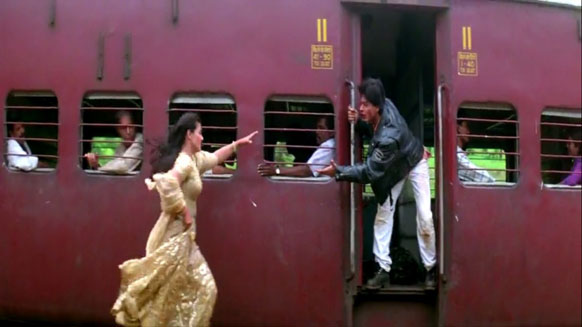
We all have blown whistles when Raj lets out his hand to Simran to help her board the train. But what happens next is not something worth whistling. How does one behave with a woman one just met? By flashing her bra in front of her and then practically wriggling into her. Raj almost has his head in Simran’s lap when her friend comes to her rescue. How cool is that? People might call it the way ‘it’ happens but clearly Raj sure proves that he is an ‘Indian’ by doing that. I would expect a better Raj had DDLJ been made with just a little more thought.

Love is blind and ‘stupid’ too

I sometimes wonder what the scriptwriter had in mind when he was writing the movie. Raj nags Simran for marrying a man whom she has barely met. It is completely understandable. It is quite obvious, from the way he nags her, that he is attracted to her. What puzzles me here is that how has he fallen in ‘love’ with a stranger he met a few days before and has spent one or two days with. That is basically the same thing he has been nagging about to Simran. Raj is no better than her father’s choice. Additionally, he is a proven pervert. And the way Simran responds by turning back when Raj expects her to, is equally psychic. How love happens in this movie, is as messed up as its other parts.


On top of that, Raj’s psychic instincts do not just go away like that. When he decides to go back to see Simran and tell her about his love, he finds that she has left for India. It is interesting to see how he finds that Simran loves him back too. He finds a bell hanging outside her house, the one he had given her when they had parted after their holiday. He takes it as a symbol of her love.


Really! I mean she could have left it just outside her house thinking it was useless to take back to India. How intelligent of Raj to fly back all his way to India just because he found a bell outside her house. It is no wonder that the audiences choose to ignore all of it. Because they have the ‘feel-good’ feeling.

The Convenient Ending


The climax of the movie is too much dramatic when Simran’s father lets her go with Raj on the train. But I do not get the hang of it. This is because what they both leave behind is equally messy as their supposed ‘Happily ever after’ lives would be. Let us think about Kuljeet (Parmeet Sethi). A happy man about to be married. Everyone in his family is excited, all his relatives have come to attend his wedding. Enter Raj, his friend whom he has brought home. Only to realize later that the same man betrays him and runs away with his bride. He ends up beaten, dejected and humiliated.


Baldev, a man of Indian values who has come to India to marry his daughter off only to let her run away with a stranger who had earlier lied to him to buy beer from his store in London. Preeti (Mandira Bedi), who, though mistaken, likes Raj and finds herself cheated not because Raj does not like her back but because he was an imposter looking to grind his own axe. The list goes on. Not even a convincing end to the story.

Final Word

The movie lacks realism and is notional in its conceptualization of everything: love and India, for example. The reason for its immense popularity is perhaps its music and its ‘lack of realism.’ An average cine-goer goes into the cinema hall with an expectation to watch something over-the-top and not something realistic. Realism is perhaps sought by the intelligentsia who have the time and resources to debate over movies. The common man, perhaps, wants a relief from his already sad ‘realistic’ life, he doesn’t want the same life depicted on the celluloid screen. He wants some magic. ‘DDLJ’ does that and more. It gives him the ‘feel good’ feeling.

Originally published on thecinemaholic.com on 6th October, 2017.

Saturday, 15 August 2020

Midnight in Paris [2011] Review: A Theme Park Ride into Nostalgia and Paris

Can you picture how drop-dead gorgeous this city is in the rain? Every city has its own character, at least in Woody Allen’s films. There are countless times when we hear that a good story must hold itself on its own, it doesn’t really matter where it takes place. That is certainly untrue if the city happens to be Paris. ‘Midnight in Paris’ is Woody Allen’s attempt at dealing with everything that is either Parisian or else something that has come to be associated with himself.

New York has been a city that Allen has portrayed a lot in his work. His best works, Annie Hall and Manhattan have a lot of the city itself in them. The hustle-bustle, loneliness, dysfunctional relationships, and the idea of a city busy with itself creep in effortlessly into these films. Midnight in Paris could well be a French arthouse film. It has a lot of elements associated with the ‘cerebral French filmmaker’. It could find itself being discussed in intellectual circles: men with receding hairlines, dark suits, thick-rimmed acetate glasses, cigarettes, and coffee, debating on its relevance. But what pulls the film out of a select audience and a monotonous commentary is Allen’s narrative and direction.

Midnight in Paris is about a couple vacationing in Paris. Gill Pender (Owen Wilson) is a jaded yet successful Hollywood screenwriter who is trying to write his first novel. His fiancée Inez (Rachel McAdams) is the daughter of a rich businessman and wants to live a luxurious and materialistic life in Malibu. Gill is a completely different person, though. A romantic at heart, he wants to settle down in Paris and write real literature instead of writing forgettable scripts to earn a fat paycheque in Hollywood. He has also fallen prey to what is referred to as the ‘Golden Age thinking’. The idea that the era that has gone by is far better than the times one lives in. Further down the story, he actually gets to time travel to the age he thinks is the golden age: Paris of the 1920s. He meets literally everyone from that era: Hemingway, the Fitzgeralds, Picasso, Matisse, Dali, and so on. He finds love in Adriana (Marion Cotillard), who is also prey to his thinking. For her, the best era is the Belle Époque.


The movie starts with a 3 ½ minute montage of Paris with Cole Porter’s ‘Let’s Do It’ in the background. It is easy to see that Paris is indeed a place that attracts dreamers and romantics. The cinematography of the movie is especially brilliant. The way the city is portrayed in warmer colors in all its glory makes it highly palatable. The lights that shine on cobwebbed buildings, the orange glow on the Seine, the ambiance of the 20s Paris draw even the driest viewers into the romantic daydream.

The movie explores a variety of themes: romance, existentialism, modernism, nostalgia. But essentially it is about a man trying to come to terms with a conflict he has been carrying on for a while. The conflict is a celebrated debate, though. Whether what has passed is the golden age or the one we live in? And whether an existential and materialistic life is happier than a fulfilled life following one’s true calling?

Gill finds himself conflicted not just in terms of life choices he must make but also in the love of three women. His current fiancé, Inez, a representative of his current existential life, materialistic and morose. Adriana, his passionate dreamy love from the era he longs to visit, Paris of the 20s. And then there is Gabrielle (Léa Seydoux), a fresh respite from the morose existence and the delusional past, who welcomes his idea of staying in Paris and its beauty in the rain.


The movie is not free from the clichés that have come to be associated with Woody Allen as a writer and filmmaker. He has survived for far more than his fair share of making films relevant to the times. The fact that some still manage to move audiences speaks volumes about his vision. Gill is the non-conformist protagonist who doesn’t really fit into the scheme of things as it were. Ernest Hemmingway is the feisty man who equates the absence of fear to making true love to a woman. Salvador Dali is a surrealist who would rather focus on his baritone than the problem at hand. There is humor in the chaos, soft sarcasm in difficult situations. As usual, the end is open for a new beginning, only one believes that it isn’t too late.

Midnight in Paris is a giant merry-go-round in the theme park that happens to be Paris. Everyone can take a ride, though everyone won’t be equally impressed. Allen’s ability to infuse pertinent themes of existence and nostalgia into a narrative around Paris and its history of art is certainly praiseworthy. The present in the film is a bit problematic, yet the glorious past fuses well with the narrative. This is certainly not the best offering from him, his best has long been in the past. But Midnight in Paris is a worthy contender if we consider his recent work.

Originally published on www.highonfilms.com on 11th June, 2020.

Sunday, 18 August 2019

Sacred Games Season 2 [Netflix] Review: A long and hard look at India's dark underbelly

Sacred Games Season 2/Netflix


Sacred Games Season 2 premiered on India’s 73rd Independence Day. It had a lot more burden of expectations on its shoulders as compared to the previous season. The reason is quite evident. The first season struck a chord with the Indian audiences and the cliff-hanger ending made the audiences wait quite eagerly for the next installment. The second season delivers on the promise by a good stretch- although the only drawback the narrative has is the spoofy demeanor and an overtly stretched story.

The reviews to the Sacred Games Season 2 started appearing very soon, in a couple of hours from the show’s airing. These reviews are a little short-sighted. The reason being the fact that most of them are based only on the first three episodes- Netflix has only that much to offer for the sake of reviews. Watching the entire set of eight episodes makes the experience a lot better because the starting episodes are quite sluggish in their pace as well as treatment. But the story starts gaining solid ground by the fourth one, and things move much better than on.

Watching the second season evoked mixed feelings as a viewer. There are many reasons for this. For one thing, the second season is a little gentler on the gore, violence and crassness, although the audiences have by now not only adjusted to it but even appreciated the treatment.

The second season employs more story arcs than the first one. It is much more reflective on human nature and relationships and even lends a perspective on the political narrative in India for the last 25 years. Reportedly, it has even exhausted the material from the original book which means that for the third season to air, the 
screenwriters have to move beyond the book. It is a tricky thing- the narrative has been quite stretched already. Too much of anything is bad.

The second season brings into the picture the larger story of modern India. It is no more surprising that Vikram Chandra spent almost a decade writing the book on which the show is based. And the story has its own unofficial affiliation- based on the collective narratives of dozens of policemen, film people, gangsters interviewed by Chandra and his equally famous friend, S. Hussain Zaidi.

It is quite appalling how politics, crime, religion and bigots are parts of the same wheel, completing and aiding each other. Even Chandra mentioned in an interview that what he set out to write originally was a 300-page thriller, which turned into a 900-page mammoth once he realised the width of the canvas he was looking at.

The story takes up exactly from where the first season ended. Ganesh Gaitonde (Nawazuddin Siddiqui) is given a new life and forced to leave Mumbai post-1993. He becomes a pawn in the hands of the RAW and starts a business in Mombasa, Kenya to further the interests of IFS Trivedi as well as K.D. Yadav, his handler from the RAW. Back in present-day Mumbai, Sartaj Singh (Saif Ali Khan) discovers Gaitonde’s bunker which leads him to the news of an imminent nuclear threat on Mumbai. Enter Guruji (Pankaj Tripathi), the religious fanatical leader who has insane thoughts about the current civilization and how to lead the world into ‘Satyug’- the purest age in Hindu mythology. The plot is weaved around these three major arcs with small intermittent arcs all around.

This season, like its predecessor, has some really outstanding performances. Nawazuddin Siddiqui is brilliant in his crass portrayal of the ‘Mumbai Bhai’. His role has been toned down in this season a bit. Working as a pawn in the hands of RAW, politicians and ultimately the Guruji makes him reflect on his reality. This also lends perspective into his insanity in the first season. His performance is more on the lines of a spectator witnessing a brilliant play that ultimately leads to destruction.

Saif Ali Khan gives an understated yet on-point performance as the ‘righteous yet self-doomed’ cop in this season. This time a lot more has been reflected in his tragic personal life. His broken marriage, his guilt over his subordinate Katekar’s death, his own exhaustion with the world and his timely pilgrimage to the Guruji’s ashram seeking answers- all makes sense.

But Pankaj Tripathi, through his portrayal of Guruji, clearly gives the breakout performance of this season. His role as the surprisingly calm guru with the most insane ideas of destroying the entire civilization to redeem the glory of past ages is perfect. His articulate use of mythological tales about ages and characters blends in very well with the narrative. Following his impressive acting, both literally and in the act, is Kalki Koechlin as Batya Abelman- Guruji’s closest aide and his ‘mistress’.

The best female role, however, is that of the RAW agent K.D. Yadav played by Amruta Subhash. A gender flick from the book, where Yadav was a man, she is the handler of Gaitonde in Kenya. And like many women in the previous as well as this season, she has handled his brash male personality rather too well. Extremely stoic and unaffected in her outlook, she represents the lives Intelligence agents actually live. Playing people against each other for the sake of the country slowly reaches to the point in life when there is probably no difference left between right or wrong. Ranvir Shorey has less screen time in the show but makes use of whatever is at hand as the terror mastermind, Shahid Khan.

The show has obvious limitations, also, this time. While the first season enthralled the audiences with this brand new world of a ‘bygone era’, this season has many narratives that the audiences have grown up watching in their own ways. Whether it is the religious extremism holding ground in India, the rampant corruption in the Police, Pakistan’s obsession with blowing up India, the silent communal divide in the country- each of these tonics has been sipped by the audiences over the years. The tricks get stale. Also, the narratives aren’t completely original. Suleiman Isa’s escape to Dubai post-1993 Mumbai blasts is similar to what Dawood Ibrahim did back then. Gaitonde’s attempt to finance a film on his own life is quite similar to what we heard in an 
audio conversation between Chota Shakeel and Sanjay Dutt with Mahesh Manjrekar playing the filmmaker.

The reference to Ram Gopal Verma isn’t quite subtle when calling the director making Gaitonde’s film as Ram G. Verma. The portrayal is quite spoofy as well as superficial. Guruji’s ashram is an obvious nod to Osho’s ‘Rajneeshpuram’ in Oregon, USA and the character of Batya loosely fits that of 
Ma Anand Sheela.

Sexually fluid orgies, blood-red pills inducing hallucinations, funding illegal trades and armed rebellions have been in the repertoire of religious bigots-‘babas’- for some time now. The idea of a pure Hindu race isn’t new either. So, is the story of ISI being complicit in every terror attack in India. The season might make it to some American University’s essential viewing list someday but this ‘primer’ on the Indian story isn’t entirely alien at least to the Indian audiences.

Above all, the show raises some deep philosophical questions. When Batya asks Sartaj whether the world he is so keen on saving is worth it- it does create a strong question. The moral ambiguity cannot be starker than it gets in the show. Mumbai, in its essence, does represent the inherent rottenness of the glamorous and shiny humanity.

Sartaj’s own lonely life and his inner fears show us, in light, the life of the man who is on the run to save Mumbai. It is moving to see how a good Constable’s son turns towards religious vandalism after his death. How a Muslim Inspector, Majid Khan, has to seek the patronage of a highly corrupt DCP to escape the unnecessary attention Muslim cops face in Mumbai post-1993.

Ganesh Gaitonde’s breakdown at the end shows us the inherent weakness he has been carrying around all the time. How a religious bigot manages to leverage his influence to erode an entire city from India’s map is disturbing. It shows us exactly how far this country has come away from ignorance.

There is a scene where a woman is at the mercy of both Sartaj as well as Gaitonde, being shot by them in the first instance. While Gaitonde eventually kills his woman, Sartaj chooses to spare the life of his victim. It is a classic contrast between the two major characters. While having similarly troubled lives, it is their choices that make them different.

Season 2 ensures that Sacred Games permanently enters the pop culture of India. While the first season gave us the oft-quoted line 
‘Bhagwaan ko maante ho?’, the second season will have its fair share of memes with universal acclaim to lines like ‘Guruji ka pyaar’ and ‘Balidaan dena padega’. Not many authors writing about India have had the privilege of getting their work adapted on screen. The select few who had the privilege, almost all were upset with the way their works were destroyed to turn them into the ‘quintessential Hindi picture’. The legendary R.K. Narayan was quite upset with what Dev Anand did to his book to make the most critically acclaimed movie of his career. I am sure Vikram Chandra would probably be happier than R.K. Narayan was.

Rating: ★★★★

Sunday, 11 August 2019

The Best Leonardo DiCaprio Movies

Leonardo DiCaprio in Once Upon a Time in Hollywood/Sony Pictures


Leonardo DiCaprio belongs to a dying breed of actors- the breed of the ‘superstars’. Just as the age and times of the ‘great filmmaker’ have started dwindling, so has been the fate of our superstars. Today, we have a ‘boutique’ variety of entertainers. Actors work for TV as well as films and probably dabble in a dozen other pursuits. But our boy is not that guy, he is still the star. He is around, but not readily available. He is working but only in the finest projects of this age. And when the man is not buying islands or paintings for his mother, he is an environmentalist-a good enough hobby for a consummate bachelor in his 40s. The greatest testimony of his stardom, though, is him being the cause of the ‘breakup’ between Martin Scorsese and Robert DeNiro- a romantic relationship that lasted for three full decades, giving us the finest movies of our lives. But then, enters Leonardo DiCaprio making Scorsese embark on another relationship – Giving us five solid movies as of now. There must be something about him because the auteur has not collaborated this long with any other actor (DeNiro being the only exception).
When Chris Rock hosted the 2016 Oscars, he obviously trashed the lack of diversity at the Oscars taking a dig at Dicaprio for ‘getting great roles every year’. This is where he went a little astray- no one really ‘gets’ roles in Hollywood-actors ‘earn’ them. Leonardo Dicaprio has been in the show business for more than 20 years. And, while he may not be ‘the greatest actor in the last two decades’, he has indeed delivered some of the finest performances in these years and that too, rather consistently. Here is a look at the maestro’s ten films which have been indeed both great as well as brave.

Inception (2010)

Christopher Nolan is a filmmaker who grew up studying the works of the legends of the Hollywood New Wave-something which he has incorporated in his films in an extremely refined way. Inception is the bravest as well as a truly original film to come from him. A science fiction thriller, which is about a thief who implants ideas into the subconscious minds of his target, this is arguably DiCaprio’s best performance. He shines as the man who, though tormented with his past, is extremely feisty in his action filled present. The set designs and visual effects are obvious signatures of Chris Nolan. Hans Zimmer has done a very groovy score for this epic, short of Gladiator and Lion King probably. Marion Cotillard is indeed the finest French actress of the present times to have crossed over in Hollywood.

The Departed (2006)

The most ‘Scorsese-esque’ movie to come out of the collaboration between Martin Scorsese and Leonardo DiCaprio, it was quite a head turner at the Oscars-winning Best Director, Picture as well as a well deserved Best Actor nomination for DiCaprio. Based on a riveting story of two moles-one in the Massachusetts State Police and the other in the gang of an Irish Mob boss, this cat-mouse chase epic was received very well by the critics. DiCaprio was intense and brilliant in the role of a frustrated cop forced to prove his allegiance to his department, while Jack Nicholson wasn’t bad either in his role of a charismatic gangster.

Shutter Island (2010)

Leonardo DiCaprio plays a dangerous murdering lunatic in this movie- Scorsese’s tribute to the film noir of the 40s and the thrillers of Alfred Hitchcock. Shutter Island is a very different kind of a movie relying on the psychological thrill of a secluded island, hallucinations, murderous delusions, all delivered along with the brilliant soundtrack featuring composers like Mahler, Penderecki, Ligeti, Cage and Ingram Marshall.

The Revenant (2015)

DiCaprio finally quenched his long due Oscar thirst with this Western masterpiece by Alejandro González Iñárritu. Based on Michael Punke's 2002 novel of the same name, the movie talks about the life and the heroic survival of frontiersman Hugh Glass played by Leonardo DiCaprio. The semi-biographical epic also has great supporting performances by Tom Hardy, Domhnall Gleeson, and Will Poulter. The movie was quite the rage at the then awards with DiCaprio picking up the Oscar, BAFTA, Golden Globe, Screen Actors Guild Award and Critics' Choice Award for Best Actor.

The Wolf of Wall Street (2013)

If there is one film that had the audiences worldwide assured that DiCaprio would clinch the Oscar that year, it was this mad movie by Martin Scorsese. DiCaprio gave one of the finest performances of his career playing Jordan Belfort, a Wall Street broker turned fraudster. The Oscars left the audiences shocked when the Best Actor was clinched by Matthew McConaughey for another great performance in Dallas Buyers Club. Based on a true story, the movie is a classic take on the hollowness of the ‘American Dream’- an obsession that pushes its taker into depths unfathomed. The movie also had Jonah Hill playing the role of Belfort’s friend-a camaraderie rarely seen between two actors in recent years. Margot Robbie was noted far and wide, credits to the movie’s appeal.

Blood Diamond (2006)

DiCaprio has mastered playing the anti-hero in tightly scripted thriller movies. Blood Diamond is another of those thrillers where he shines as a Rhodesian gunrunner cum diamond smuggler trying to keep his sanity during the Sierra Leone Civil War. Winning another Oscar nomination for his performance, the DiCaprio movie is notable for portraying the atrocities of war in African nations and how exactly they serve as foil for extracting resources like diamonds for the western nations. Djimon Hounsou and Jennifer Connelly give solid performances too.

Titanic (1997)

Perhaps, it is the most popular movie of DiCaprio till date. The movie launched him to instant stardom, the ‘Titanic Kid’ was all over the place due to this one film. Interesting, however, is the fact that the movie has managed to stay in the pop culture even now. Fan theories and instant adulation is still bestowed on this movie. Recently, when DiCaprio was promoting Once Upon a Time in Hollywood, he was asked the biggest question- whether the wooden plank had space for two people, a reference to the climax of the movie. The actor couldn’t help but grin silently.

Nevertheless, it is one of the most revered romance epic of our times telling the story about how two people from different classes, unlikely to meet, fall in movie. It was the biggest movie at the launch of its time, quickly turning into the highest grossing movie. The movie not only launched DiCaprio to stardom but also gave instant recognition to Kate Winslet, relatively unknown at that time.

Catch Me If You Can (2002)

Steven Spielberg tried his hands on this biographical film about a con man Frank Abagnale who, before his 19th birthday, successfully performed cons worth millions of dollars by posing as a Pan American World Airways pilot, a Georgia doctor, and a Louisiana parish prosecutor. DiCaprio turns on his usual charm to play Abagnale- a typical con man role which has been doing so well for years now. The film is notable for bringing out his versatility to light and hence helping him with breaking away from the mould of a romantic lead- something that has immensely helped his performances over the years.

The Aviator (2004)

Martin Scorsese has indeed elicited the best from DiCaprio-utilizing him to every inch in his movies. The Aviator may not be the greatest performances of Leonardo DiCaprio but is certainly a valuable addition to his illustrious repertoire of biographical movies- quite a good deal of them. Although quite sluggish in its pace and treatment, DiCaprio manages to make the audience sit through his portrayal of Howard Hughes, an aviation pioneer and director of Hell's Angels.

Once Upon a Time in Hollywood (2019)

Claimed to be Quentin Tarantino’s love letter to the 1960s L.A., Once Upon a Time in Hollywood has been getting rave reviews. Apparently, the movie received a seven minute standing ovation at the Cannes Film Festival- Tarantino’s home turf ever since he clinched the Palme d’Or for Pulp Fiction 25 years ago. Extremely well shot, with meticulous attention to the aura of 1960s Hollywood, the movie talks about the lives of a movie star Rick Dalton (DiCaprio) and his stunt double Cliff Booth (Brad Pitt). Along with this story we have a real life crossover-the ‘Manson Murders’. Sharon Tate, played by Margot Robbie, was pregnant with Roman Polanski’s child when she was killed by someone from the Manson family. So, we have a lot going on in this film- supposedly Tarantino’s second last as a direction. Oh, and yes, there is cute fight scene between Cliff Booth and Bruce Lee- apparently Tarantino’s Kung-Fu movies’ love comes around in his movies, even in those he just writes (True Romance opening scene was quite ‘Tarantinoed’).

Honorable Mentions

Django Unchained (2012)

Quentin Tarantino has an interesting and almost pervasive tendency to revisit history through his own movies. Django Unchained is the auteur’s nod to the ‘Spaghetti Westerns’ of the 1960s with a unique revisionist history. The movie is about a freed slave, Django (Jamie Foxx) and a bounty hunter, Dr. King Schultz, (Christopher Waltz) who set out to free Django’s wife from the plantation owned by Calvin Candie- a charismatic but a very cruel white man. DiCaprio does not have much screen time as compared to the other two, but delivers a brilliant performance as the prototype racist white plantation owner. There is even a scene where he actually cut his hand with glass but nonetheless continued acting in the scene as if the whole thing was staged.

The Great Gatsby (2013)

DiCaprio plays a famous millionaire, Jay Gatsby, in this romantic drama based on F. Scott Fitzgerald's 1925 novel of the same name. The film was co-written and directed by Baz Luhrmann. Supporting DiCaprio, in this film adaptation of a literary magnum opus, is his old Hollywood buddy- Tobey Maguire. The movie is about the love and obsession of a millionaire for a woman called Daisy, who he had hoped to marry once, but she gets married to someone else. As always it is DiCaprio’s show all the way.

Gangs of New York (2002)

This movie would have it to the top had it been a list of Daniel Day Lewis’ best performances. It took Martin Scorsese twenty years to develop the script for this magnum opus on the roots of New York- the confrontation between Catholic immigrants and native Protestants. Daniel Day Lewis, in a right nominated Oscar role, plays the cruel Protestant leader while DiCaprio takes on the role of the son of a dead immigrant leader. DiCaprio’s role is obviously less meaty and gets even more toned down considering the fact that he, arguably, faces the greatest actor alive. Yet, it is one of the memorable performances of him playing the underdog who rises through his ashes to fight for the righteous.

Saturday, 3 August 2019

The Pianist (2002) Review: A poignant commentary on the horrors of The Holocaust


Context. Perspective. Aftermath. These words are continuously called into the minds of the viewers while watching Roman Polanski’s masterpiece, The Pianist. A favorite at the then award shows sweeping multiple awards, including the Palme d’Or and the Academy Award for Actor, Director, Screenplay- The Pianist is a very strong representation of the sensibilities prevailing during the Holocaust.

‘Context’ becomes very important while watching the movie and rightly so. After all, how could the millennial generation understand something that is entirely alien to them? The world is radically different today, we do not have any great wars. Yet, the world is becoming increasingly paranoid. The great wars were fought on lofty ideals, today there are no great ideals- just identity theft. And while there are umpteen reasons why a movie such as this would never reach this generation as much as the previous ones, it does open doors- we need to see what happened then and make of it whatever we want to.

‘Perspective’ is another important thing that comes into play here. Often, it is has been seen that historical narratives are biased or one-sided, at best. While everyone is free to offer their own narratives, it is the narrative backed by the most powerful agency that endures. American narrative on the world wars has not only dominated academia but the film industry as well. War, however horrific, definitely makes some people very rich. Well, in the case of Hollywood, it has continued to make filmmakers very rich.

While there are indeed some films which stand out as brilliant, many of them are flawed narratives. The whole American narrative focuses on the triumph of the righteous, while graphic violence cluttered with technology is used to add effect to it. War seems a just reason to redeem the world and everything in between seems justified. But, there is a completely different narrative, mostly untold in Hollywood- that of a survivor’s. The survivor is not portrayed as a hero like in the American narrative- he has somehow survived by running away and not fighting injustice. The wounds inflicted are permanent and nothing goes back to normal once the war is over. There are no medals of honor nor any celebration of the war heroes, only a sense of profound loss.

The Pianist has two Holocaust survivors- Roman Polanski and Władysław Szpilman (Adrien Brody). Polanski himself escaped the Kraków Ghetto when his mother died. It is quite obvious that his narrative would be quite different as well as uncluttered from technology- something American filmmakers haven’t done yet. The movie opens to a brilliant piece by Chopin played by Szpilman, who is a pianist at the Polish radio station. Poland has just been attacked by Germany and we get to see how this affects the life of Szpilman and his family. The movie is the story of how he survives the horrors of the Holocaust through sheer luck and desperation. The walled ghettos are a site in the movie and how millions of Jews were exterminated in Operation Reinhard makes for a nauseous viewing.

Violence is quite graphic in the movie- shooting of Jews in the heads, burning down of hospitals and buildings, a man in a wheelchair is tossed off a balcony, a man lying injured in the road is run over by a tank. But it is not without purpose like some other movies. Polanski has a difficult story to tell and his art shines throughout the movie. A particularly touching scene in the movie is where Szpilman’s entire family shares a caramel before being sent away to the extermination camp. The profound sense of shattered families and lost homes is heartbreaking and this is where the sheer cruelty of Nazis shines on us.

Adrien Brody delivers a stellar performance. His transformation from a suave pianist to a desolate skeleton desperate for survival is outstanding. The movie manages to use him well. However, the last leg appears stretched and creates a sense of monotony. A lack of sense of drama is also visible which, though is a chilling portrayal, gives the narrative a lull. The rest of the characters come and go just as they are meant to in a lone survivor’s life. A particular thing which seems lacking in the narrative is Szpilman’s reaction to the murder of his family and his losses in general. He seems to go all the way quite numb to everything that has happened in between. The only reaction powerful enough is when he plays Chopin’s ‘Ballade No. 1 in G minor’- a reminiscent of his earlier life as a pianist in stark contrast to what the war changed him into.

The cinematography of the movie is top-notch. Polanski’s own background seems to help the cause of filming well. The movie was primarily shot in Babelsberg Studio in Potsdam, Germany where most scenes of the ghetto and neighborhood were shot. Soviet barracks were created and even the hospital was used to provide realism to the visual narrative. The flow of the movie is such that it grows on the minds of viewers- slow but tender. This lends a sense of drag in some parts of the narrative due to less visual tension but at the same time, it makes the narrative sensitive and real.

The Pianist has a difficult story to tell, especially when the story is nearly biographical. The irony at various points in the movie is starkly evident. War has a strange effect on people- it reduces them to gut-wrenching survivors. Szpilman’s journey from a successful pianist to a numb survivor is proof of that. The movie does end on a positive note. It shows the transcendent and unifying nature of music and art. But it never talks about the ‘Aftermath’. What inspired the worst in humankind is another story. But, yes, the aftermath is still scary-the wounds this deep rarely heal. The Pianist remains one of the best works of Polanski while also being the most touching. The movie has some minor flaws but how can the true account of a Holocaust survivor be entirely perfect? 

★★★★½

Sunday, 23 June 2019

Velvet Buzzsaw (2019) Review: Art, Horror, Chills.

Featured in IMDb Critic Reviews

All Art is dangerous. At least in Dan Gilory’s Velvet Buzzsaw. Art, as a medium of expression has been in our society since ages. It is as old as mankind itself and has truly evolved as much as human beings over the centuries. But what is more important is the fact that the perceptions we hold about art, both historic and modern, are not entirely our own. They have been greatly influenced by people who judge art. Critics, reviewers and academicians review it, rate it and judge it. And the opinion passes on to the general public. But who judges those who judge art ? Isn’t art entirely subjective ? How can we rate a wall mural and a Turner painting on similar scales ? Can art follow the patterns which critics want it to ? Can we truly isolate the artist from the art ? Are critics free from any bias, malice or greed ?

Velvet Buzzsaw is a fairly avant- garde attempt at satirizing the art community, with splashes of dark comedy and supernatural horror throughout. The movie sets out to achieve a very ambitious goal but somehow misses it. Many A listers form the impressive cast: Jake Gyllenhaal, Rene Russo, Toni Collette, Zawe Ashton, Tom Sturridge, Natalia Dyer, Daveed Diggs, Billy Magnussen, and John Malkovich.

It opens in an art exhibition in Miami where we get to see the art scene. Art critic Morf Vandewalt (Jake Gyllenhaal) walks in with his friend Josephina (Zawe Ashton) who works for Rhodora Haze (Rene Russo), an ambitious and keen art gallery owner. But that is what it seems on the surface. There is more to just art. It is business and capitalism that has engulfed it. Rhodora is keen on getting Damrish (Daveed Diggs), a new independent artist, for her agency. On the other hand, Jon Dondon (Tom Sturridge), a rival of Rhodora, is keen on persuading a veteran artist Piers (John Malkovich) to leave her agency and join him. Morf’s love life is in shambles and he starts a sexual relationship with Josephina. The movie sets the right mood for a beginning. The art scene in Los Angeles juxtaposed with the messed up and ambiguous lives of people involved in it. Shades of neo-noir.


The movie hints at picking pace when Josephina discovers a dead body of an artist, Vetril Dease, in her apartment building. She steals his paintings and shows them to Morf and Rhodora, who find them very impressive. Rhodora decides to display them and mint money through it. And with this starts a vicious chain of people each of whom get a share of the pie. Morf gets some art pieces and the rights to a book on Dease, Josephina and Rhodora mint money and Dondon seeks to destroy the image of Dease as a lunatic. Most characters are drawn into the scene, each standing to gain something out of it. The horror starts then. Slowly everyone starts getting killed. It is here that the movie loses pace and becomes predictable. The reference to the evil greed and selfishness of people associated with art seems clear and nothing surprises anymore. The screenplay shows signs of weakness as it doesn’t hold the situation very well and starts giving away the suspense too easily.


The cinematography and imagery of the movie deserve applauds. The blue labyrinthine sound room and the artistic ‘sphere’ which kills Gretchen (Toni Collette) look amazing. The deaths of the major characters are equally poetic and metaphorical. Morf is killed by the same Hoboman, which he had criticised at the Miami exhibition. Josephina gets stuck on a wall mural which she had disapprovingly made fun of in front of Damrish. Rhodora is killed when her Velvet Buzzsaw tattoo animates itself and slashes her. The paintings of Dease have an eerie quality to them and show disturbing events from the past. Most of them do materialize into reality. The motifs are not very subtle but are clear in conveying the message.

The performances in the movie are quite decent. Gyllenhaal is absolutely amazing as an astute art critic who does not compromise on his artistic vision, whether he is attending an art exhibition or a funeral. Russo does her job well as the eternally persistent gallery owner who knows what she wants. Others are good too. Malkovich isn’t used much but he adds his characteristic touch as the reticent and alcoholic artist who nurtures art and looks at the commercial agents with disdain.


The movie has its moments and deserves praise for its material and visual treatment. However, it does falls short on its ability to deliver a hard hitting story and climax. The motifs and the cinematography are there but it appears like a false ceiling ready to give way as soon as the burden becomes too much. Perhaps, it is too much to expect from a feature film to delivers answers to questions so deep. But the movie is clearly not aimed at answering any questions. What then it sets out to do ? The answer to this question isn’t there. What we do have is a horror film with moments of dark humour, some of them uncalled for. 

Originally published on www.highonfilms.com on 24th June, 2019.

Thursday, 19 July 2018

'Sacred Games' : Could they get any dirtier ?


‘Sacred Games’ is a story about Bombay. I have to admit that I like Bombay more than Mumbai. The difference does not just lie in the nomenclature. It lies in the times and the colors that have come and gone by over the years. Bombay is not just another city. It is more of an entity that has grown up and evolved as much as the people of this country. And that transformation has underneath it, a host of stories, tales, myths and what not. Bombay was a brilliant cauldron which immersed in itself every single emotion that a human being feels : greed, jealousy, ambition, power, love, betrayal. And it had a place for every other person in its belly : actors, gangsters, prostitutes, businessmen, politicians, pimps, low life addicts, power brokers, journalists and so on. Strangely, all of them were virtually connected in this ghost like city which had place for the elite in its brighter quarters and its dark old alleys held regard for the downtrodden.

Bombay became Mumbai somewhere down in the late 1990s when probably the crime syndicate shifted gears to foreign lands. Although shreds of the old days still lurk around the corners and the new city has been galloping breathlessly yet the old days were brilliant. There was violence, crassness, bloodshed and mafia: all in bad taste but it was brilliant. The criminal underbelly of Bombay had its hands pretty much in every pie and had this invisible presence around the country and even abroad. Bombay was, and probably is, a kind of subcontinent in itself and had a flavor like the Banarasi Paan: distinct and killer, which could easily outmatch the rise of American Mafia in the neighborhoods of New York and the liquor dens of Chicago. Probably it has not received the kind of coverage its other counterparts have.

The Hindi Film Industry, quite ironic since the Bombay Mafia had quite deep roots in the industry itself, has produced quite a number of films that give us an insight into the intricacies of the Bombay Underworld. Some of them have been exceptional : ‘Parinda (1989)’, ‘Satya (1998)’, ‘Vaastav’ (1999) and ‘Company (2002)’ to name a few. But each of them has suffered two basic problems. First problem is the industry itsel : the format is such that they have to tell a story with conviction in just two hours and also include lame songs and romance to cater to audiences who otherwise would not care enough to watch them. It is quite difficult to deal with a topic as detailed as this in such a limited time. Second, the ecosystem in which such films are made is rife with questionable censorship and lack of suitable means to reach international audiences.

‘Sacred Games’ is one such online TV show streamed on Netflix which not only overcomes the above two problems but also tells the rich and brilliant story of the labyrinths of Bombay and its sordid nooks and crannies. It is perhaps the best attempt at dealing with the subject.

The Plot and the Characters


‘Sacred Games’ is about Bombay and what happens in it around a certain period of time. The storyline is non linear with splashes of the erstwhile chapters of a crime lord and a present day chase to save Mumbai from an imminent threat. ‘Sacred Games’ follows Ganesh Eknath Gaitonde, a dreaded gangster, who suddenly appears in Mumbai after 15 odd years. He calls up Inspector Sartaj Singh, a middle-aged policeman with a below average service record and a broken marriage, to inform him of an imminent danger to the city in 25 days. What happens next is a wild goose chase that shakes up the entire system. Interlaced within this gritty action is Gaitonde’s own history of how he makes it to the top of the mafia starting his life a nobody.

At its core ‘Sacred Games’ is dark, depressing and crass. Violence, Sex, Drugs and Religious Bigotry find detailed attention in it. Yet the story has a mythical vibe to it. It tends to grow on the minds of the audience given the sheer intensity of the world it transports its viewer to.

A good thing about the show, however, is the Netflix medium which is liberating at its best. There is no censorship on the medium, which is a double-edged sword. It allows the filmmakers, Anurag Kashyap and Vikramaditya Motwane, to give considerable attention to their subject and the freedom to craft their cinematic vision. However, that has caused considerable crassness, gore and violence to seep in which is a fine line to walk: Audiences could appreciate or reject this with equal ease.

The show’s characters are flawless and this makes it easier to serve the plot to the audiences since it tends to get dull at times. The attention to detail is another aspect which the show has catered to. The evolution of Bombay from the 70s to the present time is worth appreciating. The novel Sacred Games, on which the show is based, itself was quite evocative , weaving images of burgundy shoes, a green sofa and sequinned sarees to the distinct marathi flavour in the dialogues spoken by the constables. The detailing lends itself well to the screen— be it the kada worn by Sartaj Singh, or the long-collared, full sleeved shirts sported by Gaitonde, reminiscent of the ’80s.

The presence of Nawazuddin Siddiqui as Ganesh Gaitonde is menacing and he consumes the entire space in his scenes. His art of storytelling is mythical and his crass abuses add flavour to the kind of profession he belongs to. His intensity and his belief in himself creates the vital ground upon which the whole drama unfolds.


Then we have Sartaj Singh, an Inspector of Mumbai Police, in his middle age with a broken marriage. Rather plump for the profession he is in, he is resented by his colleagues and enjoys little respect in the department. Sartaj, an honest cop dealing with the failures of the system, finds himself in the midst of a turmoil when Gaitonde enters his life. Many small characters add the necessary edge to this complex Bombay story : the mildly corrupt yet empathetic Constable Katekar, the hot headed Hindu gangster Deepak “Bunty” Shinde, the cold assassin Malcolm Mourad, the mature and know-it-all DCP Parulkar and the devout religious fanatic IFS Trivedi.


The show’s portrayal of its women is quite admirable. Most of these are strong characters who give their male counterparts a run for their money. RAW agent Anjali Mathur is courageous, determined and adamant to serve in the field. Kuckoo, the glamorous transgender has a strange magical attraction and she makes her suitors prove their mettle. Zoya Mirza aka jamila is the quintessential Bollywood actress but has a dark past of her own and is willing to stake anything to have her own way. Subhadra, Gaitonde’s wife, is quite vulnerable around him but has a strong will when it comes to lead Gaitonde on the right path. Kanata Bai has a fierce temper but has a lot of acumen when it comes to deal in the illegal business.

Originally published at www.thecinemaholic.com on 18th July, 2018.

Extremes

The other day I was sipping tea by my balcony's window, You know those languid hours, when ideas mostly come and go, A strong wind swept...